Posts
Alien Stones from Space !!
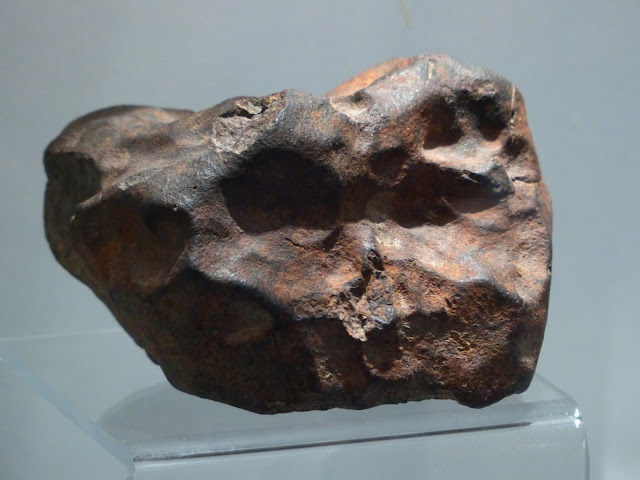
Many people have some unique interesting hobbies, one of that is collection of heavenly stones (Meteorite Stones). We can also find a museum at Chicago called "Garden of Heaven". Garden of Heaven is museum of meteor stones collected from different places and different continents. For some this is business, to hunt for meteor stones and sell at very high price. So where do these 'Heavenly Rocks' come from? Meteorite Stone Most of the meteors belong to Asteroid belt between orbits of Mars and Jupiter, but few of them belonged to Moon and Mars!! Sometimes when a massive Asteroid hits surface of Mars, small surface objects on mars bounces and leaves gravity of Mars. When such objects are captured by Earth's gravity, they enter into Earth's atmosphere. Similarly different objects arrive from Moon. This is possible because Mars has weak gravity and moon being closest to Earth with very weak gravity. Mechanic Farmer is a well known name of Meteor...
Popular posts from this blog
Samir Palnitkar Solution Manual Free Download PDF of Verilog HDL

This is a solution guide to the exercises of the book "The Solution Manual of the Verilog HDL: A Guide to Digital Design and Synthesis by Samir Palnitkar". Following are the Solutions to Solution Manual on Verilog HDL: A Guide to Digital Design and Synthesis by Samir Palnitkar , exercises of all chapters in the book. Chapter 1 ----------------- No Exercises ---------------- Chapter 2 : Hierarchical Modeling Concepts Chapter 3 : Basic Concepts Chapter 4 : Modules and Ports Chapter 5: Gate-level Modeling Chapter 6 : Dataflow Modeling Chapter 7 : Behavioral Modeling Chapter 8 : Tasks and Functions Download Solution Manual: Click on this link (Mega.nz Link) [Solution Manual to Verilog HDL: A Guide to Digital Design and Synthesis by Samir Palnitkar] Preview of Solution Manual: For Verilog Programs: Go to Index of Verilog Programming Tags: Verilog HDL solutio...
Verilog: 4 Bit Full Adder Behavioral Modelling with Testbench Code
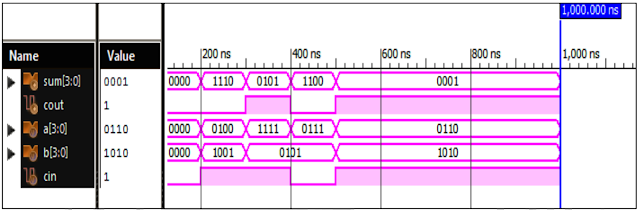
Verilog Code for 4 Bit Full Adder Behavioral Modelling with Testbench Code module 4_bit_Add( input [3:0]a,b, input cin, output [3:0]sum, output cout ); reg [3:0]sum; reg cout; always @ (a or b or cin) assign {cout,sum}= a + b + cin; endmodule //Testbench code for 4 Bit Full Adder Behavioral Modelling initial begin // Initialize Inputs a = 0; b = 0; cin = 0; // Wait 100 ns for global reset to finish #100; // Add stimulus here #100 a=4; b=9; cin=1; #100 a=15; b=5; cin=1; #100 a=7; b=5; cin=0; #100 a=6; b=10; cin=1; end initial begin #100 $monitor (“ a = %b, b = %b, cin = %b, sum = %b, cout = %b”, a, b, cin, sum, cout); end endmodule Xillinx Output: 4 Bit Full Adder Behavioral Modelling Response Also See: List of Verilog Programs
VLSI: 4-1 MUX Dataflow Modelling with Testbench
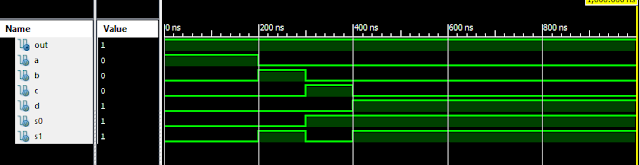
Verilog Code for 4-1 MUX Dataflow Modelling module m41(out, i0, i1, i2, i3, s0, s1); output out; input i0, i1, i2, i3, s0, s1; assign y0 = (i0 & (~s0) & (~s1)); assign y1 = (i1 & (~s0) & s1); assign y2 = (i2 & s0 & (~s1)); assign y3 = (i3 & s0 & s1); assign out = (y0 | y1 | y2 | y3); endmodule //Testbench code for 4-1 MUX Dataflow Modelling initial begin // Initialize Inputs a = 1;b = 0;c = 0;d = 0;s0 = 0;s1 = 0; ...
Verilog: 4 Bit Counter Behavioral Modelling using If Else Statement

Verilog Code for 4 Bit Counter Behavioral Modelling using If Else Statement module 4_bit_Count( input clock, reset, output [3:0]dout ); reg [3:0]dout; initial dout = 0; always @ (posedge (clock)) begin if (reset) dout <= 0; else dout <= dout + 1; end endmodule Xillinx Output: 4 Bit Counter Behavioral Modelling Response Also See: List of Verilog Programs
Verilog: 1to 8 DeMultiplexer (1-8 DEMUX) Dataflow Modelling with Testbench Code
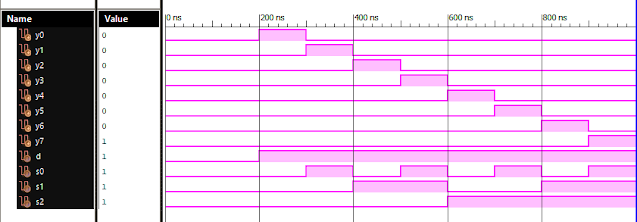
Verilog Code for 1 to 8 DeMultiplexer Dataflow Modelling module demux_1_to_8( input d, input s0, input s1, input s2, output y0, output y1, output y2, output y3, output y4, output y5, output y6, output y7 ); assign s0n = ~ s0; assign s1n = ~ s1; assign s2n = ~ s2; assign y0 = d & s0n & s1n & s2n; assign y1 = d & s0 & s1n & s2n; assign y2 = d & s0n & s1 & s2n; assign y3 = d & s0 & s1 & s2n; assign y4 = d & s0n & s1n & s2; assign y5 = d & s0 & s1n & s2; assign y6 = d & s0n & s1 & s2; assign y7 = d & s0 & s1 & s2; endmodule //Testbench code for 1-8 DEMUX Dataflow Modelling initial begin // Initialize Inputs d = 0;s0 = 0;s1 = 0;s2 = 0; // Wait 100 ns for global reset to finish #100; // Add stimulus here #100; d = 1;s0 = 0;s1 = 0;s2 = 0; #100; d = 1;s0 = 1;s1 = 0;s2 = 0; #100; d = 1;s0 = 0;s1 = 1;s2 = 0; #100; d = 1;s0 = 1;s1 = 1;s2 = 0; #100; d = 1;s0 = 0;s1 = 0;s2 = 1; ...