Posts
Earn Money Online: RevenueHits CPA Ad Newtwork Review 2020

RevenueHits is one of the most popular ad networks with international coverage. Revenue hits is not an ad network for new blogs or website with low traffic because it does not pay on CPM basis but it pays on CPA basis. They won't count your impressions or clicks but only actions. What is CPA? CPA is Cost per Action. That means user should not only just click on your ad but also performs any action after clicking on ad, like signing up some newsletter, installing application, filling up survey form,etc. only then you will get paid. Nowadays very few people will click on ad and give their emails. RevenueHits is well-known for it's advertisement type CPA. Reveuehits is high paying ad network but it requires users to perform action after clicking on ad. If you have popular website with lots of traffic I would strongly recommend to use this ad network as a secondary ad network. There are good chances a to earn money from RevenueHits equivalent to AdSe...
Popular posts from this blog
Samir Palnitkar Solution Manual Free Download PDF of Verilog HDL

This is a solution guide to the exercises of the book "The Solution Manual of the Verilog HDL: A Guide to Digital Design and Synthesis by Samir Palnitkar". Following are the Solutions to Solution Manual on Verilog HDL: A Guide to Digital Design and Synthesis by Samir Palnitkar , exercises of all chapters in the book. Chapter 1 ----------------- No Exercises ---------------- Chapter 2 : Hierarchical Modeling Concepts Chapter 3 : Basic Concepts Chapter 4 : Modules and Ports Chapter 5: Gate-level Modeling Chapter 6 : Dataflow Modeling Chapter 7 : Behavioral Modeling Chapter 8 : Tasks and Functions Download Solution Manual: Click on this link (Mega.nz Link) [Solution Manual to Verilog HDL: A Guide to Digital Design and Synthesis by Samir Palnitkar] Preview of Solution Manual: For Verilog Programs: Go to Index of Verilog Programming Tags: Verilog HDL solutio...
VLSI: 4-1 MUX Dataflow Modelling with Testbench
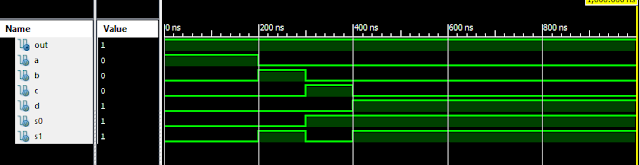
Verilog Code for 4-1 MUX Dataflow Modelling module m41(out, i0, i1, i2, i3, s0, s1); output out; input i0, i1, i2, i3, s0, s1; assign y0 = (i0 & (~s0) & (~s1)); assign y1 = (i1 & (~s0) & s1); assign y2 = (i2 & s0 & (~s1)); assign y3 = (i3 & s0 & s1); assign out = (y0 | y1 | y2 | y3); endmodule //Testbench code for 4-1 MUX Dataflow Modelling initial begin // Initialize Inputs a = 1;b = 0;c = 0;d = 0;s0 = 0;s1 = 0; ...
Verilog: 4 Bit Full Adder Behavioral Modelling with Testbench Code
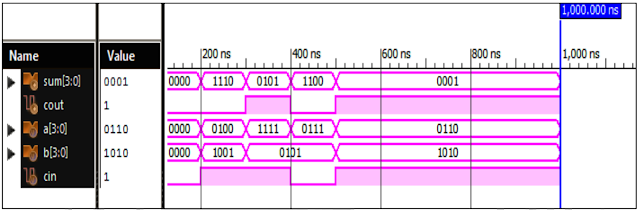
Verilog Code for 4 Bit Full Adder Behavioral Modelling with Testbench Code module 4_bit_Add( input [3:0]a,b, input cin, output [3:0]sum, output cout ); reg [3:0]sum; reg cout; always @ (a or b or cin) assign {cout,sum}= a + b + cin; endmodule //Testbench code for 4 Bit Full Adder Behavioral Modelling initial begin // Initialize Inputs a = 0; b = 0; cin = 0; // Wait 100 ns for global reset to finish #100; // Add stimulus here #100 a=4; b=9; cin=1; #100 a=15; b=5; cin=1; #100 a=7; b=5; cin=0; #100 a=6; b=10; cin=1; end initial begin #100 $monitor (“ a = %b, b = %b, cin = %b, sum = %b, cout = %b”, a, b, cin, sum, cout); end endmodule Xillinx Output: 4 Bit Full Adder Behavioral Modelling Response Also See: List of Verilog Programs
VLSI: 8-3 Encoder Dataflow Modelling with Testbench
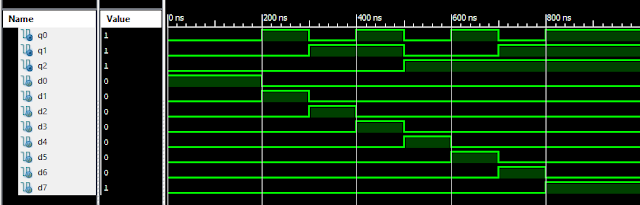
Verilog Code for 8-3 Encoder Dataflow Modelling module encoder_8_to_3( input d0, input d1, input d2, input d3, input d4, input d5, input d6, input d7, output q0, output q1, output q2 ); assign q0 = ( d1 | d3 | d5 | d7 ); assign q1 = ( d2 | d3 | d6 | d7 ); assign q2 = ( d4 | d6 | d5 | d7 ); endmodule //Testbench code for 8-3 Encoder Dataflow Modelling initial begin ...
VLSI: BCD to Excess 3 and Excess 3 to BCD Dataflow Modelling

module bcd_ex3_Dataflow( input a, input b, input c, input d, output w, output x, output y, output z ); assign w = (a | (b & c) | (b & d)); assign x = (((~b) & c) | ((~b) & d) | (b & (~c) & (~d))); assign y = ((c & d) | ((~c) & (~d))); assign z = ~d; endmodule Excess 3 to BCD: module ex3_to_bcd( input w, input x, input y, input z, output a, output b, output c, output d ); assign a = ((w & x) | (w & y & z)); assign b = (((~x) & (~y)) | ((~x) & (~z)) | (x & y & z)); assign c = (((~y) & z) | (y & (~z))); assign d = ~z; endmodule